Great Cheeses from ACS 2012: Part 2

As ACS gets further and further away, I want to round things up with a couple more posts. First off, here is part 2 awesome cheese that I tasted at the conference. I didn’t make it to every booth at Meet The Cheesemaker – and I’ve have mentioned a lot of other great cheeses in previous entries – but these are the other cheeses that caught my attention this year.
DSC01328

Baetje Farms They simply make some of the best goat cheese in the country. I had never heard of them before I judged the American Dairy Goat Association contest one year and their “St. Genevieve” took 2nd place overall. This year they took two blue ribbons, one for Couer de la Crème and one for Bloomsdale. Amazing cheese, if you can find it. They even have a website now, which they didn’t the last time I wrote about them. From Bloomsdale, Missouri.

Jacobs and Brichford — Arabella Generally, I avoid cheese companies that sound like lawyers, wineries,or bad indie rock bands but this cheese is really good. Basically it is a raw milk, washed rind, farmstead cheese that is basically a Taleggio. But a really awesome Taleggio! Pasture-based seasonal dairy. From Connersville, Indiana.

Rogue Creamery – Oregon Blue The Rogue boys hardly need my help or publicity. Heck, they’ve already won Best in Show a couple of times. I just want to pause and say again how awesome their cheeses are. This year the I actually considered the Oregon Blue for my top three and – generally – I consider that their least interesting cheese. I think I may undervalue that cheese because it is the only one we used to carry before David and Cary took over the company and it gets lost in the Rogue River/Crater Lake/Caveman/Flora Nella excitement. Let me state here and now, this is an awesome cheese too! From Central Point, Oregon.
IMG_2594

MouCo Cheese Company — Ashley
Since I previously mocked Sartori for their inernet spelling of BellaVitano consider MouCo mocked as well. You people are ruining literacy. Get off my lawn! That being said, I would buy this cheese in a second. This won a blue ribbon in the soft ripened cheese category over two of the best soft-ripened cheeses made in the US: Harbison and Green Hill. That should make anyone sit up and take notice. An ashed-rinded cow’s milk cheese that is oozy, rich, buttery, mushroomy, and just plain awesome. Plus on facebook they once posted a picture of a punk rocker working in the aging room so that gets extra bonus points. From Fort Collins, Colorado.

Laura Chenel – Melodie I guess I developed a weakness for ashed cheeses this year… Having tasted Melodie since its early (French-made) versions, I was super impressed with this cheese. It is better than it ever has been and now it’s made in California. I do not know of a better US-made goat brie in this 1 kilo format. Well-balanced tang, rich, great creamy texture. Yum. Made in Sonoma County, CA for the Rians Group, France.
DSC01326

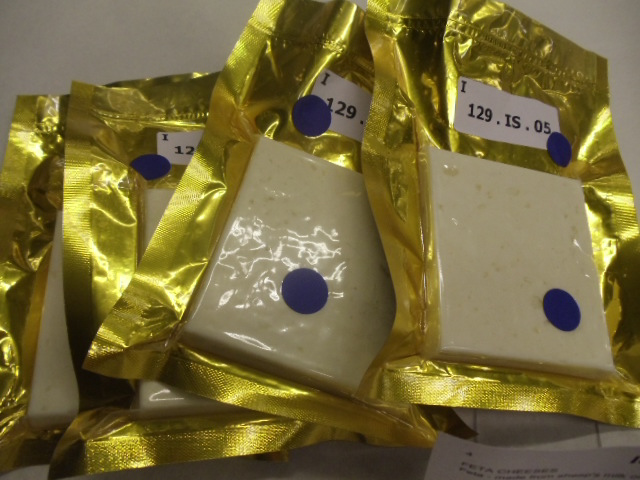
La Moutonniere — Sheep Feta This ran away with the sheep feta category. Rich, nutty, milky-sweet, and a great balance of salt. I don’t know much about these folks except that they are a farmstead sheep dairy in Quebec. If you up in the Great White North, check ‘em out!
DSC01324

Beehive Cheese Company – Teahive Once upon a time these folks called me up asking for a quote for an episode of the Today Show where their Barely Buzzed was going to be featured. I don’t know if they have ever really forgiven me for responding with, “Finally, a cheese with stuff in it that doesn’t suck!”* Anyways, Teahive doesn’t suck either. In fact, since it is coated with Earl Grey and Bergamot Oil – combined with Barely Buzzed and its espresso rind – we have been selling the two of them together as a Utah speedball. As always with Beehive’s cheese, the sum is greater than its parts. In all seriousness, don’t be too high and mighty to enjoy a cheese with stuff. This cheese is awesome. From Uintah, Utah.
DSC00043

Sierra Nevada Cheese Co – Fresh Chevre Sierra Nevada makes the best Cream Cheese in the country and one of the few that is all natural. We have been carrying their bulk fresh chevre for years as well and it is nice to finally see it recognized for the high quality cheese that it is. “Best Chevre” is a bit of an on-any-given-day crapshoot as an award, but this is solidly good and previous under-recognized. From Willows, California.

Nordic Creamery – Goat ButterI tasted this during the Best of Show go-round and was wow’d. This may be the best goat butter I’ve ever had. From Westby, Wisconsin.

*I sent them a usable quote as well! That one was just more forgettable.
**Oh yeah, Karoun won again for their Labne. Simple cheeses never get their full due so let me say that this Labne — along with Bellwether Crescenza and Franklin’s Teleme — is one of the best cheeses made in this country that people just don’t pay enough attention to.

Great Cheeses from ACS 2012: Part 1

DSC01357

I am only mentioning cheeses that are new to me here because – as anyone there can attest – there were too many awesome cheeses for one person to blog about. My versions of these from past years are still pretty much valid, so check those out as well if you want.

Here is a list of things that got my attention at ACS 2012.

Ist runner up Best of Show
Valley Shepherd — Crema de Blue
DSC01332
Cleary this cheese was ripped apart by the judges in the best possible way.

I had never heard of this cheese or cheese company before the judging. I love it that a cheese like this can be recognized in a competition this big. It speaks well to the competition and shows how important a blind judging is to reward less well-known cheeses. Crema de Blue is – like the Flagsheep – a mixed milk cheese, sheep and cow. As the name would imply it is rich and creamy with a very well-balanced blue flavor, assertive, but not overpowering the milkiness of the cheese. I love natural rinded blues! Again, wish I could get my hands on this one.

2nd runner up Best of Show
Emmi Roth USA — Roth Grand Cru Surchoix
DSC01363

This is kind of a previous Best in Show winner. Under a slightly different name (“Roth Kase — Grand Cru Gruyère Surchoix”) this same basic cheese won it all in 1999. Since Emmi owns a company with actual name-controlled Gruyere in Switzerland (as well as Cypress Grove Chevre in California), they are moving away from calling their Wisconsin version by that name, which I do think is admirable. Whatever they called it, they make one of the most solid alpine-style cheeses in the country. They even imported those cheese flipping robots (which one is not allowed to photograph in their warehouse!) which are just about the coolest cheese thing ever.

Sequatchie Cove Farm — Dancing Fern
DSC01323

This is the one cheese I voted for in my personal top 3 which didn’t make the Best of Show/Runners up list. This is the best American version of a Reblochon that I have ever tasted. Reblochon is, for the most part, illegal in the US because it is made with raw milk and aged less than 60 days. The imported pasteurized versions just do not satisfy. While I often buy a larger format, legally-raw-milk version made in France, it is great to see one made closer to home… and from a farmstead, pasture-based dairy no less!

Made in Tennessee, this is just one of the amazing Southern cheeses that are super hard to get outside the South. I am so glad the ACS decided to go to Raleigh this year (even though it was the 2nd straight year on the East Coast) because it really let those of us who live far away get exposed to great cheese we may not know about otherwise. (And hey, I’ll be back in the South in October for the Southern Artisan Cheese Festival in Nashville! Tickets go on sale this week)

If you are local, we actually have some of this cheese in the store right now… but probably not for long.

American Cheese Society 2012: Best of Show

It’s always an amazing moment at the awards ceremony when it is time for Best of Show. I like to sit in the front row so that people can’t see that I always cry when the award is announced. An incredibly loud “OH MY GOD!” came from the back of the audience when this name went up on the screen… and I just couldn’t help myself. Congratulations on all the hard work.

2012 Best of Show:
Flagsheep – Beecher’s Handmade Cheese
DSC01321

After all the individual category winners are chosen, all the 1st place winners get shuffled off into another room so that the judges can taste all of them in order to determine Best of Show. Generally, I go through the room tasting everything, marking down any that are amazing enough that I think they may qualify for my top three. During this whole time judges are not supposed to talk to each other so the room is eerily silent. For about an hour the only sound you hear is the chopping of knives and the soggy plop of half masticated cheese hitting the spit buckets.*

Still, I knew this cheese would be popular when I physically bumped into Marianne Smukowski in front of a bandage-wrapped mixed milk cheese while trying to get a second taste. We didn’t say anything then, but in the waiting room after we had turned in our ballots she asked me if I voted for it and I said yes. When some other folks chimed in as well, I knew that it would be recognized. That is the weird thing in the judging room. I usually think I will be the only one voting for the cheeses I select. Before I turn in my sheet I always say to myself, “Even if no one else votes for these cheeses, will you be proud of your decision?” When my answer is yes, I know I am ready to vote.

The Flagsheep we tasted was awesome and truly deserved this honor. A sheep/cow bandaged-wrapped Cheddar with a ton of complexity: sharp, sweet, nutty, grassy… just amazing. When I tasted it against the other 10-12 cheeses in my informal top tier ranking, I knew I would vote for it as my top aged cheese.

I just wish I could get my hands on some now that the show is over. Word is that they only had 23 wheels aged and ready to go and that they were all allotted.

Here is their happy cheesemaker.
DSC01373

*Most of you will be relieved, and only a few sickos disappointed, that the picture of my spit bucket was too overflashed to bother posting here. Hopefully they will ask me to judge again next year so I can get a good one.

American Cheese Society Conference 2012: My panel

When I committed to judging and doing a panel at ACS, I didn’t really map out the timeline in my head. Here was my schedule for the first few days of ACS:


Monday: Get to SFO at 5:30 AM, Arrive North Carolina 5:30 PM, eat BBQ and try to fall asleep early. Succeeded on the eating, failed on the sleeping.

Tuesday: Meet for judging at 7:30 AM East Coast Time (4:30 my time), judge for 8 hours tasting 50 or so cheeses, drive (thanks again Tim Gaddis and family!) 45 minutes to cheesemonger party (Thanks Alexander Kast and family!). Get drunk, but not enough to be hung over for:

Wednesday: Meet for judging at 8 AM, judge 50 cheeses plus taste another 100 to decide on Best of Show. Find out winners at 7 PM then immediately go to dinner meeting with Debra Dickerson and Jeanne Rodier to discuss panel. Go back to my room and scribble notes until well after midnight.**

Thursday: Do panel at 10 AM to a packed house (because retailers came out in droves for the certification test this year) and collapse into a little puddle.

The best part of this is that I really didn’t have time to get nervous about my panel. When I moderated a panel in Chicago, I was a nervous wreck for days; here I was only a mess for one night!

Our panel was called “Handling Cheese in a Retail Environment” and very quickly I realized the confusion between what we had prepared for and what was expected from the audience. The main theme running the entire conference was food safety. Between the implementation of the Food Modernization and Security Act and the increased enforcement and inspection of creameries and stores there was a lot to talk about and many panels discussing those head on. We were planning a talk on cheese quality, not the legal intricacies of water content and recorded accountability trails, so things went a little off the rails.

Then one of the things that make the ACS great happened. Oh, there’s a question about storage temperatures and the water level of cheese? Oh, let’s call on one of the two dairy scientists who authored the definitive paper on that subject* because she just happens to be in the room. Awesome.

DSC01337
(Marianne Smukowski hijacking our panel.) 😉

Until I went to the annual business meeting at lunch where these was a remembrance of Daphne Zepos, I had no idea that our moderator was going to be delivering a eulogy to one of her best friends in front of about a thousand people mere minutes after our panel was finished. My hat’s off to Debra because I could not have done that myself. The memorial, and the announcement of the Daphne Zepos Teaching Award, was incredibly moving. Surely not as intimate as the memorial at the Cheese School, but there were few dry eyes in the house, even among the folks who never met her.

*”Storage Temperatures Necessary to Maintain Cheese Safety”, JAY RUSSELL BISHOP and MARIANNE SMUKOWSKI, Wisconsin Center for Dairy Research, University of Wisconsin, 2006.

**I didn’t even have enough time to make the Culture Magazine event that I really wanted to go to!

When cheese fights back

I guess I have one more thing to say about judging… most of the cheese was good to excellent. But we had one cheese that was so bafflingly bad that we had to call over other judges just to be sure how awful it was.

DSC01317

It was a mild style of cheese, so when I first put it into my mouth I didn’t expect a blast of flavor. However I didn’t expect to taste an absence of flavor either… literally nothing but texture for one beat, two beats… then, after being lulled into a moment of false security… BAM! incredible, horrid bitterness. It was like a IED made by vegan guerillas. My judging partner and I could have been entered in the synchronized spitting competition in the Olympics trying to get this cheese out of our mouths. The only comparison I can think of for this kind of nasty is getting skunked. Not only was it bad, but it wouldn’t go away easily. We had to take a break to cleanse our pallets: bread, pineapple, melons, milky tea. I needed my tongue for the rest of the day; we had another 25 cheeses to taste.

Another judge who works as a consultant with that style of cheese hovered nervously, hoping he wasn’t associated with it. (He wasn’t, as it turns out.) Mysteriously, all the other cheeses by the same company (I don’t know which company, but the coding system enables judges to know the entries originated from the same place) were pretty good. Judging has its risks and pains, but I have never had a stealth attack from a fresh cheese before. Careful out there folks.

Cheese Vote: 2012

I was going to write another entry on judging, but I think I said everything that I wanted to yesterday. So instead, please vote for whose cheese animal is better:

My “Suggestion of Animal with Pointy Ear”
DSC01314

Or Luis’s “Pasty Cheese Duck”
DSC01305

American Cheese Society 2012: Judging

Whenever I get a chance to be a cheese judge at the American Cheese Society Conference, I grab it. I really do love it. I am honored to be asked – and that is part of it – but I love it mostly because it is pure cheese: just me, my mouth, and 1771 anonymous cheeses.

DSC01310

Of course I don’t have to taste all 1771 (or whatever a given year’s number is). Judges only have to taste around two hundred: one hundred assigned via category, then another hundred that won their class and are competing for Best of Show. Still, it’s a lot of cheese over the course of two days. I am not complaining, however. Not at all.

I have written about judging before, but every competition has its own merits. Many cheese judgings use the 4H method, which is non-numerical. There are variations but usually judges taste and then (in their heads) rate the cheese before announcing “Gold,” “Silver,” “Bronze,” or “No award.” If judges are unanimous on “Gold”, the cheese is awarded “Double Gold” and those go into consideration for Best of Show.

Other competitions are scored technically. Dairy scientists are looking for perfect versions of a cheese by type. You have never seen Wisconsin dairy science folks excited until you see them hotly debating the merits of the Colby category!* Technically perfect cheese usually wins these competitions whether or not they are complex or powerful.

At ACS the technical judges are teamed up with aesthetic judges (cheese professionals who are not dairy scientists) in a good cop/bad cop situation. Technical judges start from 50 and grade down for mistakes. Aesthetic judges start from zero and award points for positive attributes. In this way a cheese may even get deductions and positive points for the same flavor attribute. An extremely sweet Cheddar, for example, may lose a little for not being classic, but may gain a lot if that aesthetic judge sees value in its unusual flavor attributes. This means that both technical cheesemaking and innovation can be rewarded in the same contest. It is also why cheese with big flavors usually wins Best of Show.

I have seen critiques of the ACS judging for this reason. I don’t believe that a technically perfect fresh mozzarella, for example, has ever come close to winning Best of Show. It can win its category, but BoS winners are usually in the Alpine family, blue category, washed-rinds, or aged: in other words, the big flavored cheeses.

(Sorry, Little Guy)
DSC01308

Which makes perfect sense since the ACS was set up to support cheesemakers making innovative cheese. Almost every cheese that has won in the last decade has been a cheese that, upon tasting, a customer at some point has asked me, incredulously, “That cheese was made in the US?” This comment – once an every day occurrence – is dying out these days as people realize the breadth of cheese styles now being made extremely well in this country. And I think the ACS competition has played a part in that growing awareness.

The other thing I love about the ACS competition is how seriously people take it. I mean sure, my fellow judge and I did make some cheese animals out of pasty, non-winning cheese, but the judging itself, and the writing of commentary on the judging form was our priority. Also, unlike other judgings I have taken part in where – embarrassingly and unprofessionally — people openly discussed the cheesemakers and their history (“Leticia’s*** cheese has gotten so much better over the years. I know she has a new aging room now and it really shows”), that would just not be tolerated at ACS. If the judging committee didn’t notice it, other judges would.****

DSC01315

Lastly, what everyone – retailers, cheesemakers, cheese eaters reading this etc. — needs to keep in mind is that we can only judge the cheese in the room. I had a cheese that I usually love that was not at its best last week. As a cheese seller of many years, there is no way not to recognize the distinctive characteristics of some cheese, even if I actively avoid acknowledging I recognize it to my fellow judge or letting it sway me, good or bad. On a normal day, I know that cheese to be better than what I tasted in that judging room, just like I know that some winners never tastes as good when I try to order it for the store. Come to think of it, that would be an awesome contest too: a consistency competition where the same cheeses are tasted in, say, 6 different batches over the course of the year. But in this judging, we can only judge what is in front of us.

Anyways, I will post tomorrow about some of the great cheeses and winners at this year’s competition, but today I just wanted to set the stage. Judging. It’s awesome.

*I will be mocked by my Wisconsin friends for this, but until I judged I never thought of Colby as anything other than mild Cheddar. Since then, I just pretend there’s a difference.**

**Kidding! Kind of!

***Obviously this is a name chosen because it was not one of the actual name used. In this way I am remembering Leticia’s restaurant on Market St. whose closing has left a little hole in our hearts.

****I am still kicking myself for not reacting strongly enough at one non-ACS judging. After loudly discussing every cheese’s origin as they judged it, one individual came to one that they didn’t recognize and asked me if I knew what it was. I responded, “Why do you need to know who made it to judge it?” They responded to me, “Why do you think that would affect my scores?” I didn’t realize that “blind judging” was an ambiguous term.

Congtatulations Beechers Handmade Cheese!

Best of Show: Beechers Flagsheep

A truly awesome cheese!

*Yes, my laptop keyboard still has a broken apostrophe key.  Sorry!

Book signing at ACS

I will be doing book signing from 10-10:30 Friday at the conference bookstore. I mean, I am willing to sign a book at ay time, but I will actually be sitting down, not distracted, and have a pen in my hands that specific half hour.

Come say hi!

Gordonzola’s humble suggestions for getting the most out of the cheese conference

I’ve lost track of how many ACS conferences I have attended. I pretty sure I have attended every one not on the East Coast since 1999. Almost universally, they have been awesome experiences that have taught me innumerable things about cheese and introduced me to people I otherwise might never have met.

Back when I first started going, there were only about 300 people attending the conferences but still, I didn’t know anyone except for a handful of California cheesemakers. While I am sometimes good about faking it, I am actually kind of shy by nature, so I am humbly going to attempt to produce a guide that I would have found useful back in the day.

I’m sure this advice will be weighted to the independent urban retailer, but hopefully others will find it helpful as well. I have never had obligatory parties to attend* or – except when the conference was in Cotati and San Francisco – co-workers to divide the day with so I’ve always had to figure out how to get the most of the events on my own. I’m sure I can’t come up with everything so, Cheese Folks, feel free to add suggestions in the comments.

Social Tips:

1. Say Hi and Introduce Yourself.
I know this is basic, but this is what the conference is for. Talk to strangers. ACS has really made this easier with both the “Meet the Cheesemaker” and “New Attendees” events. Even meeting a cheesemaker for a few minutes means that they may remember you if you call for advice or to warn them that there is something odd about a wheel you just received. Plus. This is a small world. You may see them at an event 6 months down the line where you are the only cheese people in a crowd of wine snobs and food bloggers and you will need each other for support. I have started lifelong friendships by things like striking up a conversation while waiting to wash my hands in the bathroom.

2. But Don’t Be Creepy
Cheesemakers are the rock stars of our world. Like teenager groupies, we extol their every effort behind our cheese counters. Saying something concrete about how you admire their work is awesome. “I really think your cheese has a complexity that people aren’t appreciating enough.” Asking questions is awesome, “So how many cows do you have anyway?” However, fawning is creepy. “OMG, you are my God. I came in my pants when I tasted your new triple cream.” is bad conversation starter, Goofus.

3. Respect Cultural Differences
While cheese gatherings tend to be even whiter than anarchist gatherings, there are definitely cultural differences between the rural and urban folks there. I live in a city and work in an environment where talking fast and loud is valued. ** Also, I’m a Northern Californian so oversharing is second nature. Many people at the conferences may see livestock a lot more than people. Slow it down (which is not the same as “dumbing it down”), be respectful, and meet halfway. Actually, meet them more than halfway. This is the primarily the cheesemakers’ conference, not yours.

4. Don’t try to Impress Anyone
I won’t name any names here, but those of us who have been going to ACS for awhile can all remember people who came on super strong asserting their cheese “knowledge” to everyone around them. Some people come in with only strong opinions and plenty of assumed privilege but without any sense of nuance. “XXXXXXX is the only blue cheese good enough for me to carry.” “All American Alpine-style cheeses but XXXXXX are crap.” Etc. Many of those folks are in other lines of work now. Just sayin’…

Official Events

1. Choosing Panels
I wouldn’t tell you which panels to go to, but I know that I always try to go to panels that are over my head. For example – while there are a lot of very good cheese science books out there now that non-scientists and cheesemakers can read — there were not when I first started going to ACS. I loved going to the panels that were just cheesemakers and dairy scientists arguing about things I was not near understanding. It helped (as much as possible) give me humility and made me realize how much I didn’t know about cheese. That’s a helpful reminder when most of us will know more than most of our customers after about a month of training.*** Remember to be respectful of the level of knowledge the panel assumes and who the panel is geared for. If the panel is discussing the specific flavor attributes and potential problems associated with secondary cultures in pasteurized cheese, for example, don’t ask, “What is cheese culture?” Keep your mouth shut. Soak up what you can. And do some research on your own when you get home.

Also, I differ from like 90% of you in that I decided long ago that I do not like the booze/cheese pairing workshops at ACS. It is just too big a crowd and moves to slowly for me so I never attend them even though they are always the hottest ticket. Don’t be afraid to find your own path. (Plus, getting completely drunk at the early afternoon Bourbon/Cheese pairings**** workshop at the 2001 ACS made me miss the tour of the Louisville Slugger Factory.)

2. Vote with your Feet
The ACS conference is expensive. Don’t waste your time. If a panel is bad, boring or just not geared to your needs, leave and go to another one. As a panelist, I hate this, but I understand it. Of course, I am not the kind of panelist who is using the ACS to give an informercial. If you feel like a panel is not about sharing information but merely self-promotion, you have my blessing to leave loudly in a huff.

3. Let Your Cheese Mind Wander
Staying in a panel that is not your thing has its advantages if you do not want to vote with your feet. Sometimes just one sentence or concept has sparked great ideas for improving our department. The reason we go to ACS is that it is a cheese-rich environment. Just going there and being around the cheese community can give you profound insight. When something comes to you, write it down. At one boring panel, I made a complete draft for a new kind of cheese signage for our coolers. I might never have done that bogged down in the day-to-day back home.

4. Take Notes.
I know you think you’ll remember everything, but you won’t. There is just too much. Plus, you get great tidbits like this that will make you laugh years down the line:

The French person on the panel talked about cheese sitting out on display and getting oily. One has to factor in the amount of lost weight and flavor in this situation and calculate pricing for (literal) shrink. He has a fairly heavy accent so after he bemoaned the loss my co-worker elbowed me and said, “Did he just say that cheese losing moisture is like a butterfly escaping?”

“No he said it was butterfat escaping”

“Oh, but that was so poetic.”

5. Volunteer
Some reading are already ready to mock me for this one since volunteering at ACS can be kind of a mixed bag. Let me mention first that a new management team is organizing the conferences so my previous experience is not indicative of future activity. I have had great times volunteering to plate for tastings and to cut for the Festival of Cheese***** Plus, at those things you get to meet the hard workers instead of the pretentious and flaky. If I don’t know anyone, give me some people to work on a big production project on and we will be friends for life in two hours. Just make sure you ask questions and know what you are getting yourself into. I am, frankly, still bitter about the time I was asked to deliver “a few” cases of beer to an event and it turned out to be 80 cases to two different venues, one of which didn’t have an elevator to get to the beer drop off spot. We missed lunch and the next panel!

Extra Curricular Activities

1. Visit Farms and Cheesemakers in the Area of the Conference
ACS is a busy time for the locals but it is also the time that they are expecting visitors, for the most part. Scheduling an extra day or two to the trip may seem like a hardship to your business, but it is invaluable to your ongoing cheese knowledge. For example, your regional cheesemakers may have different traditions, water use issues, equipment, philosophies, etc. than those in another region. As a Californian, when am I ever going to be in North Carolina again? Make use of the plane fare you’ve already spent. I don’t have to mention NEVER go to someone’s farm without asking first, do I?

2. Go to the Bar
This is the unofficial center of the conference. Everyone meets here on their way to dinner, everyone hangs out here after they come back. Some people actually never make it to dinner. You don’t need to drink alcohol, but this is the best chance to really get to know people and learn things about them that you probably shouldn’t talk about over the cheese counter. Do I have to say though, that no one likes a sloppy, bitter drunk? Take yourself away if you feel the need to start complaining about your boss or other people who are known in the small, small world of cheese. Oh and remember some people may actually be having business meetings here so ask if it’s ok to join people before you set up camp.

3. Dinner
This is a tricky one. Going out with folks to a nice meal is a great way to meet people. But, more than once, I have ended up going out with folks and spent way too much money. My co-op does not pay for my meals on these kinds of trips and when you find yourself picking a restaurant with folks who are on expense accounts, things can be awkward. Especially when people want to drink a lot of booze and then split the check evenly. When feeling particularly broke, I have definitely ordered an appetizer and then stopped by a liquor store later for a potato chip and Lil Debbie’s dinner. If you are at ACS on your own dime, just be aware than not everyone else is.

4. Taste
This is the most fun part of the conference. Taste everything offered to you. Taste it alone. Taste with pairings. Taste at official events. Taste at the bar. Taste warm cheese out of dirty backpacks. It’s all good. Take notes on this too, because there is no way you’ll remember the nuance of 200 different cheeses when you get home. BTW, one of my proudest professional moments is that I’m in the Cheese Nun documentary for about 5 seconds and I am taking notes at the Festival of Cheese, not mugging for the camera.

My Best Advice for the Conference

1. My best advice is really pretty simple. Enjoy being part of the cheese community. There are not a lot of us around so enjoying being around the thousand or so who are obsessed enough to travel around the country to seek it out. Sure, there is business being done and shady stuff in the corners, but soak in the pure beauty of cheese. It will keep you going throughout the year.

*The poignant lyrics of Dead Kennedys come to mind here. From “Well Paid Scientist”: Company cocktails-gotta go
Say the right thing
Don’t fidget, jockey for position
Be polite
In the pyramid you hate
Sip that scotch
Get that raise
This ain’t no party at all

** Recently a NY-based distributor complimented me on being the only person not in NY who he could talk full speed to. Heh.

***That shows how much more understanding about cheese the public is, btw. A decade ago I would have said a day of training would give a new cheese worker more info that most of our customers.

****Plus, I didn’t think any of the pairings actually worked.

*****Nearly two decades of cheese work means that my repetitive stress injuries prevent me from doing this anymore, but I would if I could.