Category Archives: Uncategorized

Cheesemonger: A Life on the Wedge

Ok, People keep asking when the book is coming out so here it is. Not available until March, but it’s never too early to pre-order. And check out the new low cover price since we’ve done away with the pretentious hard cover edition. 😉

cover pic
(Photo by awesome local photographer Myleen Hollero)

You can order direct from Chelsea Green.

Or from the bookstore of your choice (like your neighborhood worker-cooperative perhaps)

For some reason, Amazon is the only place that is posting the blurbs (though I have a few more now) and they are pretty good.

OK, self-promotion time is over (for the day).

Thanks!

Big thanks to cheese writer Laura Werlin for catching an embarrasingly stupid mistake in my manuscript at the last minute. (I wrote the the USA produces 9 million lbs of cheese yearly when I meant to write 9 billion) It takes a cheese pro to catch an error like that. My eyes went right past it at least 100 times.

I owe you one!

Bad Bocconcini

The other day Nick Mamatas asked me what my happiest day was as a cheesemonger.* Well, last Saturday certainly wasn’t it.

We had an in store demo scheduled for the week before. Even though I got about 100lbs of pre-packed bocconcini, we couldn’t sell it because it wasn’t sealed correctly and it was spilling all over the place. I figured we could give it away, but, unfortunately, it was already rancid. Yuck, spit, hawk, spit, yuck, rinse.

Because we’re good little environmentalists, I opened every package and drained it in the sink so we could compost the cheese and recycle the plastic tubs. Luckily my co-worker Minnesota Nice captured it all with action photos on his cell phone.

Mmmmmm, sink full of nasty!
bad bocconcin

Bocconcini be gone!
bad bocc4

Into the compost!
bad bocc

This is the real glamor of working with cheese… Saturday nights spent getting soaked with the smelly discharge of unsellable dairy.

*I told him he’d have to buy the book. BTW, check out this awesome mention in Publisher’s Weekly! (and don’t forget to look at the other books by Allison Hooper and Max McCallman) It even has a small glimpse of the actual cover.

I’m sick, go elsewhere

I’ve been sick the last couple of days and too incoherent to write anything here. I am feeling better though — enough to make my shift tomorrow and Thursday for the last two coupon days of the year. CRAZY.

Here’s something to enjoy while I’m absent from the blog. A Cheese Underground post by Jeanne Carpenter about the licensing of cheesemakers that has over 30 comments and much vitriol. Not much in cheese surprises me so I was pretty shocked that this was that much of a hot button issue. Good for Jeanne for writing this and stirring the pot a little.

Challerhocker 2: the questioning

I love the Challerhocker even more now than I did last week. Not only is the cheese awesome and the label super creepy:

challerhocker

But we keep getting Swiss people contacting us saying they don’t believe this cheese even exists! Now, I’m not above making up cheese names for a specific reason — *cough* Tommy Bartlett Tomme *cough* — but seriously, It’s new, it’s a great cheese and it’s really from Switzerland!

Wisconsin Whirlwind addendum

I just got sent this one last picture from Wisconsin. Here’s me smearing salt water and bacteria into a Rothkase “Gruyere”:

smearing gruyere

Totally fun! (when one doesn’t have to do it for 8 hours a day)

Challerhocker

It’s always fun when Janet Fletcher comes into the store. Janet is one of the few people who can write well about cheese without having been a cheese worker. If that sounds like a backhanded compliment, it’s not. There is a lot of misinformation and hype disguised as authoritative information and I think it’s a lot harder to sort out when you don’t handle, cut, wrap and taste a few thousand lbs. a week.

She does a weekly cheese column for the SF Chronicle so I always try to give her tastes of new cheeses for her to write about. 52 a year is no joke!

I sampled her a cheese called Challerhocker that I hadn’t even unwrapped yet and three weeks later here it is. It is truly an awesome cheese. The only thing Janet didn’t mention is that the name means something like “aged in the cellar” and has a label that looks like a child who’s been locked in the cellar for quite some time.

(I will get a better picture tomorrow)
Challerhocker

Of course the funniest thing is that someone (Hi Laurie!) wrote a pro-Gordon comment in the comments section and someone else felt compelled to write a “whatever to Gordon, have you heard of Mark Todd, The Cheese Dude?” reply.

Long-time readers of my blog may remember Mark as the guy who tasted a cheese at an event and said, “THAT’S PIMP!” in response to its excellent flavor and mouthfeel. I love Mark Todd! He’s one of my favorite cheese people. You don’t have to choose between us!

Wisconsin Whirlwind 5: Widmer’s Cheese Cellars

The last cheese factory on our trip was the smallest and most old-school: Widmer’s Cheese Cellars in Theresa, Wisconsin. Joe Widmer is a third generation cheesemaker, another Wisconsin Master Cheesemaker and is still operating out of the factory his grandfather bought 80 years ago. The family has finally moved out of the house above the factory, but that’s about all that has changed.

Here’s the “factory” with my trip mates in the foreground for scale
DSC00262

I had visited once before (on a road trip in 2005 and I actually can’t believe I didn’t write about it). Joe Widmer is one of my favorite cheese people: funny, friendly, and non-pretentious. Just look at him standing over the Brick Cheese brine tank!
DSC00254

What is Brick Cheese anyway? Why is it called Brick? If you are not from the Midwest you shouldn’t feel guilty about not knowing. Like real Colby, and fresh curds, it’s kind of a regional cheese. It’s another washed rind cheese, very stinky and strong if allowed to ripen to its full potential. Widmer actually makes two versions. They start the same, but one is annattoed up to differentiate it. That (orange) one is plastic wrapped and meant to stay milk. The uncolored one is aged longer and paper-wrapped. It’s as stinky as you want it to be.

Why Brick? Well, it’s because real bricks were/are used to weight the cheese and push out excess moisture. Here’s a third generation brick!
DSC00258

Here’s the process! (Germ-worriers please note: the brick lie on top of stainless steel forms.)
DSC00251

Plus the cheese – in a whole block – resembles a brick too. Here it is aging. Please note slimy bacteria on shelves. That’s what makes it great.
DSC00256

I don’t know why I started talking Brick cheese so early in this entry since we sell a whole lot more of his cheddar. Joe Widmer is one of the best block cheddar-makers in the country, managing to make very sharp cheddars that remain moist and creamy. Not brittle like Vermont cheddars, with (I hate to say this as a Californian) more flavor than any California blocks I’ve had. Some are scared of the orange annatto coloring to which I say, this is a Wisconsin tradition. Respect diversity!

Here it is being made:
DSC00250

And here is my favorite picture of the trip. Still life of bricks for Brick cheese at rest. Timeless, eh?DSC00252

Best dairy protest photo ever!

MilkProtest600

New York Times article on European Union Ag protests here

Wisconsin Whirlwind 4: Crave Brothers

The next stop on our journey was Crave Brothers, a farmstead dairy in Waterloo Wisconsin. It’s a big farmstead* dairy – nearly 1000 cows – and they make some of the best mascarpone in the country and one of my favorite American cheeses: Petit Frere.

This was the first time on our trip that we got to see cows. On the way there we hit massive thunder storms and thought we might not be able to visit them, but the weather cleared just as we arrived and we got the tractor tour by one of the Crave Brothers: George Crave.**
DSC00229

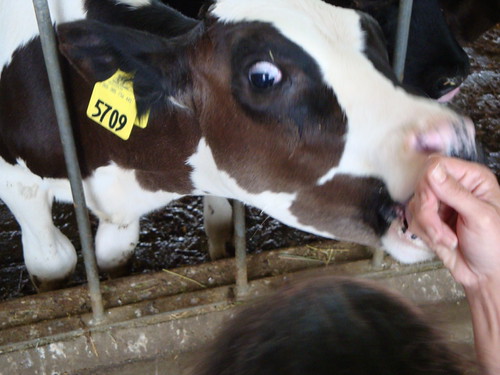
We were too late for the cheesemaking – they were already hosing down the plant – but just in time for the cows. We got slimed by the baby cows who were very excited to see us.
DSC00245

One of the best things about the Crave Brothers farm is that they have the most productive dairy farm methane digester that I know of*** producing all the energy needed to power their cheese plant as well as 120 local homes.**** They titled their press release about this “From Cow Pies to Blue Skies”. Heh.
DSC00240

It was an awesome tour. The only thing we didn’t get to see was the manure lagoon.

As for their cheese (which I feel funny writing about after typing “manure lagoon” in the last paragraph) I love their little washed rind cheese called Petit Frere (little brother). It’s rich, creamy and – if you let it ripen right – oozy and pungent. I’ve been experimenting around with them at the store and would say give it 60-65 days after the make-date on the box and it will be perfect.

*Farmstead means that the cheese is made on the farm and only from the milk of cows that live there.
** They made a point of telling us that, yes, that was their real name and not a clever marketing ploy “Crave Brothers” could go either way, eh?
***Other dairy farms are also doing this. Local dairy heroes at the Straus Family Creamery were – unsurprisingly — one of the early innovators.
**** They even made the news with this and there’s a nice little video (sponsored by Glaxo, heh)