Tag Archives: cheese

The blur of Thanksgiving week

Oh Thanksgiving, the annual American food holiday… whatever one’s political take on it it’s the traditional biggest single-day food event of the year for your beloved grocery workers.

I worked 9 straight days before the holiday (partly because I had taken the weekend before that off to drive to SoCal) so if I owe you a phone call or email, feel free to remind me. It was kind of a daze. Here are some highlights:

1. The failure of the American educational system: I understand people being a little shaky when they are entertaining their pregnant friends for a food holiday. However the lack of basic science among these people is truly frightening. Witness this exchange:

Thanksgiving Host: “I need a Gruyere for a recipe but I need one that’s pasteurized. I have a pregnant friend coming over.”
Me: “All real Gruyere is made from raw milk.* What are you making?”
(TH describes a casserole that will cook in the oven for over 45 minutes)
Me: “Well, you don’t really need to worry about it then. First, the curds for Gruyere are cooked for a long time before the cheese is made, but even with a truly raw, aged cheese, if you bake it ‘til the cheese bubbles for awhile, there’s no worry about safety. Any potential food borne pathogens would be killed by that.
TH: Look, I don’t want to argue. Just show me a pasteurized Gruyere.

(For the tenth straight year I brought my camera to work to document the craziness and then was too busy to take any pictures. Still, I wanted something to break up the text. This is what we had on sale in November)
cheese sales november 2009

2. Reps who are bored because their work is done: I understand that the week before Thanksgiving is a down time for other people. But please don’t come in to the store without an appointment the week before a holiday and try to sell me new products. It’s annoying!

2a. Immediate demands for action on things that are someone else’s fault I have one small company that just refuses to act in smart, professional ways. Generally I find it endearing, but the fact that they refuse to send invoices with their orders is annoying. Luckily I’m honest, because they don’t seem to keep business records. Sending an email that basically says, “Here are all the invoices for the last 3 months, please see which ones you’ve paid, and pay the ones you haven’t” will not be well-received any week, but especially this week. The fact that your “neighbor” sometimes gets your mail and cashes your checks is not an excuse.**

3. Misleading media on cheese The fact that many people think Humboldt Fog is a blue cheese*** is a constant cheese worker correction. No big deal. But, somewhere this year, someone must have referred to it that way somewhere in the media. In the same way that all of a sudden 20 people ask for mascarpone in the same day because it was in a Food Section recipe, people came in asking for Humboldt Fog Blue. I thought it was just me, but Sweet Cheezus and Ilipodscrill confirmed that they had the same experience too. The best was the person who asked, ‘Humboldt Fog is the same thing as Pt. Reyes Blue, right?” If only they’d added “and it’s made by Cowgirl Creamery, right?” they would have hit the most common local cheese mistakes in just one sentence.

Because I was cranky and a Californian, I replied, “You know Humboldt County is about 200 miles from Pt. Reyes, right?” If you are reading this, Bay Area Transplant, sorry for my tone!

I’m sure there’s more, but that’s all I can remember right now. Who had time to write things down last week? Not cheese workers, that’s for sure.

*Honestly, this is why I like to carry the Rothkase “Gruyere”. First off, it’s a pretty awesome cheese. Secondly, even though I am not really down with it calling itself a Gruyere since it is not from the Alps, the fact that it is not made with raw milk makes it the default pregnancy and compromised immune system cheese for that type of cheese and keeps me out of arguments about basic science.
**as it turns out we had paid (and checks were cashed, possibly by the “neighbor”) every invoice more than 15 days out.
***That’s ash, not mold. Isn’t is pretty?

Bad Bocconcini

The other day Nick Mamatas asked me what my happiest day was as a cheesemonger.* Well, last Saturday certainly wasn’t it.

We had an in store demo scheduled for the week before. Even though I got about 100lbs of pre-packed bocconcini, we couldn’t sell it because it wasn’t sealed correctly and it was spilling all over the place. I figured we could give it away, but, unfortunately, it was already rancid. Yuck, spit, hawk, spit, yuck, rinse.

Because we’re good little environmentalists, I opened every package and drained it in the sink so we could compost the cheese and recycle the plastic tubs. Luckily my co-worker Minnesota Nice captured it all with action photos on his cell phone.

Mmmmmm, sink full of nasty!
bad bocconcin

Bocconcini be gone!
bad bocc4

Into the compost!
bad bocc

This is the real glamor of working with cheese… Saturday nights spent getting soaked with the smelly discharge of unsellable dairy.

*I told him he’d have to buy the book. BTW, check out this awesome mention in Publisher’s Weekly! (and don’t forget to look at the other books by Allison Hooper and Max McCallman) It even has a small glimpse of the actual cover.

Wisconsin Whirlwind addendum

I just got sent this one last picture from Wisconsin. Here’s me smearing salt water and bacteria into a Rothkase “Gruyere”:

smearing gruyere

Totally fun! (when one doesn’t have to do it for 8 hours a day)

Challerhocker

It’s always fun when Janet Fletcher comes into the store. Janet is one of the few people who can write well about cheese without having been a cheese worker. If that sounds like a backhanded compliment, it’s not. There is a lot of misinformation and hype disguised as authoritative information and I think it’s a lot harder to sort out when you don’t handle, cut, wrap and taste a few thousand lbs. a week.

She does a weekly cheese column for the SF Chronicle so I always try to give her tastes of new cheeses for her to write about. 52 a year is no joke!

I sampled her a cheese called Challerhocker that I hadn’t even unwrapped yet and three weeks later here it is. It is truly an awesome cheese. The only thing Janet didn’t mention is that the name means something like “aged in the cellar” and has a label that looks like a child who’s been locked in the cellar for quite some time.

(I will get a better picture tomorrow)
Challerhocker

Of course the funniest thing is that someone (Hi Laurie!) wrote a pro-Gordon comment in the comments section and someone else felt compelled to write a “whatever to Gordon, have you heard of Mark Todd, The Cheese Dude?” reply.

Long-time readers of my blog may remember Mark as the guy who tasted a cheese at an event and said, “THAT’S PIMP!” in response to its excellent flavor and mouthfeel. I love Mark Todd! He’s one of my favorite cheese people. You don’t have to choose between us!

Wisconsin Whirlwind 5: Widmer’s Cheese Cellars

The last cheese factory on our trip was the smallest and most old-school: Widmer’s Cheese Cellars in Theresa, Wisconsin. Joe Widmer is a third generation cheesemaker, another Wisconsin Master Cheesemaker and is still operating out of the factory his grandfather bought 80 years ago. The family has finally moved out of the house above the factory, but that’s about all that has changed.

Here’s the “factory” with my trip mates in the foreground for scale
DSC00262

I had visited once before (on a road trip in 2005 and I actually can’t believe I didn’t write about it). Joe Widmer is one of my favorite cheese people: funny, friendly, and non-pretentious. Just look at him standing over the Brick Cheese brine tank!
DSC00254

What is Brick Cheese anyway? Why is it called Brick? If you are not from the Midwest you shouldn’t feel guilty about not knowing. Like real Colby, and fresh curds, it’s kind of a regional cheese. It’s another washed rind cheese, very stinky and strong if allowed to ripen to its full potential. Widmer actually makes two versions. They start the same, but one is annattoed up to differentiate it. That (orange) one is plastic wrapped and meant to stay milk. The uncolored one is aged longer and paper-wrapped. It’s as stinky as you want it to be.

Why Brick? Well, it’s because real bricks were/are used to weight the cheese and push out excess moisture. Here’s a third generation brick!
DSC00258

Here’s the process! (Germ-worriers please note: the brick lie on top of stainless steel forms.)
DSC00251

Plus the cheese – in a whole block – resembles a brick too. Here it is aging. Please note slimy bacteria on shelves. That’s what makes it great.
DSC00256

I don’t know why I started talking Brick cheese so early in this entry since we sell a whole lot more of his cheddar. Joe Widmer is one of the best block cheddar-makers in the country, managing to make very sharp cheddars that remain moist and creamy. Not brittle like Vermont cheddars, with (I hate to say this as a Californian) more flavor than any California blocks I’ve had. Some are scared of the orange annatto coloring to which I say, this is a Wisconsin tradition. Respect diversity!

Here it is being made:
DSC00250

And here is my favorite picture of the trip. Still life of bricks for Brick cheese at rest. Timeless, eh?DSC00252

Wisconsin Whirlwind 4: Crave Brothers

The next stop on our journey was Crave Brothers, a farmstead dairy in Waterloo Wisconsin. It’s a big farmstead* dairy – nearly 1000 cows – and they make some of the best mascarpone in the country and one of my favorite American cheeses: Petit Frere.

This was the first time on our trip that we got to see cows. On the way there we hit massive thunder storms and thought we might not be able to visit them, but the weather cleared just as we arrived and we got the tractor tour by one of the Crave Brothers: George Crave.**
DSC00229

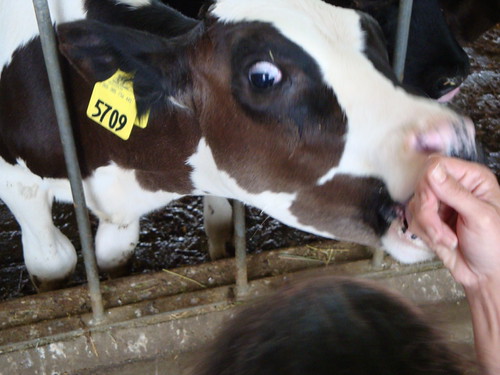
We were too late for the cheesemaking – they were already hosing down the plant – but just in time for the cows. We got slimed by the baby cows who were very excited to see us.
DSC00245

One of the best things about the Crave Brothers farm is that they have the most productive dairy farm methane digester that I know of*** producing all the energy needed to power their cheese plant as well as 120 local homes.**** They titled their press release about this “From Cow Pies to Blue Skies”. Heh.
DSC00240

It was an awesome tour. The only thing we didn’t get to see was the manure lagoon.

As for their cheese (which I feel funny writing about after typing “manure lagoon” in the last paragraph) I love their little washed rind cheese called Petit Frere (little brother). It’s rich, creamy and – if you let it ripen right – oozy and pungent. I’ve been experimenting around with them at the store and would say give it 60-65 days after the make-date on the box and it will be perfect.

*Farmstead means that the cheese is made on the farm and only from the milk of cows that live there.
** They made a point of telling us that, yes, that was their real name and not a clever marketing ploy “Crave Brothers” could go either way, eh?
***Other dairy farms are also doing this. Local dairy heroes at the Straus Family Creamery were – unsurprisingly — one of the early innovators.
**** They even made the news with this and there’s a nice little video (sponsored by Glaxo, heh)

Wisconsin Whirlwind 3: Roth Kase

While I am kind of a whiner in real life, I try to keep it off my blog. I know no one wants to read that. Still, the Cheesemaking day at Roth Kase deserves a little whining.

DSC00220

I often work at 7 AM so I don’t mind getting up early. We had to get up at 4:30 to go make cheese at Roth Kase. That would not have been a very big deal except that we were on Wisconsin time so to us it was really 2:30 in the morning. I was so obviously falling asleep on the cheese tour that I became the designation person of ridicule for the entire day. Oh yeah, now I remember why I hated school.

I blanked when asked a question so I had to stand in a cheese corner and write “We leave the vat alone while we wait for the proper PH level and for the curds to knit together,” 100 times.

We were supposed to “make cheese” and we did… kinda.* We were a large (exhausted) group doing the work of one person so it wasn’t like we were breaking sweats. We did cheesemaker things though. We cut curd, we took breaks*, we flipped havartis. It was a good day.

After making cheese we got to go down to the aging areas. We got to rub paprika into the Gran Queso and – best of all – smear bacteria into their gruyere. It’s always amusing to be in a factory “working” while the real workers get to take it easy and mock from the sidelines. If I did nothing else, at least I made one day easier for a cheese factory worker.

Roth Kase gruyere-style cheeses are really something to be proud of. Except for maybe the Pleasant Ridge Reserve (which has only a fraction of the production of Roth Kase) no one widely distributes an American cheese with a Gruyere flavor profile. We got to taste their 15 month-aged cheese and it really is everything you want in a Swiss-style Gruyere: nutty, sweet, oniony, and just a touch of pungency.

I would have taken a photo of their wall of aging gruyeres but they requested no photos for technology security reasons.*** So, instead of floor-to-ceiling cheese, here’s a picture of the hand towel in the Roth Kase bathroom:
DSC00219

I didn’t take my camera in at all because I didn’t want to drop it in a cheese vat while I “worked” but I should have more pictures soon.

*Don’t worry cheese consumers, the have a couple of old vats segregated from the rest of the cheese equipment for people like us. ( Oh, here they are!) You might eat our cheese, but only if it worked out.
**excuse me, we didn’t take breaks, we waited for the proper PH level and for the curds to knit.
***I couldn’t give you just a hand towel pic, so here’s a picture of Gruyere de Savoie in a similar aging warehouse in France. The French cheese is about 4 times bigger than the Roth Kase gruyere.
IMG_1735

Wisconsin Whirllwind 2: Edelweiss, Maple Leaf, and robots

I thought I would be bored at the slicing and shredding factory. This part of the tour was definitely organized for Lunardi’s, not us. As a one store operation, we aren’t big enough for private labels or custom blends. Still, I love factories so I was happy to go. Plus we were promised cheese robots!

First though, we got to meet more master cheesemakers. Jeff Wideman from Maple Leaf Cheese Cooperative and Bruce Workman from Edelweiss Creamery*. We carry the Maple Leaf smoked Gouda because it’s a natural cheese (unlike most smoked goudas) and I have always admired the Edelwiess Emmenthal, made in copper vats and in 180 lb. wheels like the real Swiss version.

However, the most exciting thing about the visit was the revelation that Workman had helped start the Edelweis Grazier Co-op, made up of five farmers doing rotational grazing for pasture-based milk. I had actually already ordered a cheese of theirs without knowing the whole back-story because it tasted so good! In the absence of regulation for “grass-fed” dairy** the Edelweiss Grazier Co-op members agree, by being members of the co-op, to such restrictions as 1.5 acres of pasture for every cow and to not milk at all in the winter, non-grazeable months, giving cows a much needed rest that lets them produce high quantities of milk and live , for much longer than the average dairy cow.

While grass-based dairy has obvious health benefits for the cheese-eaters, the farmers, and the farmed, the lack of any unified definition leaves is ripe for abuse in the future. Hopefully we are a few years away from Jack in the Box offering “grass-fed” *** cheese on their “local”,“artisan” ciabatta bread, but that is only as far away as the creation of a sizable market that desires “grass-fed” cheese. I hope the grass-based dairies all over the US can create some kind of agreed upon definition before this concept gets abused.

But you don’t want to hear that negativity… Look ! Robots!!!! (Unfortunately, I realized too late that you can’t rotate videos on flickr. Put your computer on its side!)

((Hmmmmm, I can’t seem to get this video to embed at all here actually, try looking for it here on my flickr It’s only 9 seconds long))

*OMG, I love the slogan “You know it’s real when it’s cut from the wheel!”
**”grass-fed” meat is regulated, just not dairy. Meat animals and dairy animals have some different needs.
***there wouldn’t be any fine print since there is no regulation, but perhaps if there were it would say, “Grass fed cheese comes from cow that get at least 1% of their daily feed through grazing (or silage).”

Wisconsin here I come!

Hey folks,

I will be on a whirlwind Wisconsin (cow milk) cheese tour so don’t expect any posts from me this week. Hopefully I’ll have good pictures and stories when I get back.

I will be back in town in time for the California Artisan Cheese Guild Benefit (held at the San Francisco Cheese School) on Friday night. If you want an evening of cheese eating, cheesemaker schmoozing, and/or something to do before the clubs open, this is well worth the $35. Reserve your spot through the Cheese School (and check out their other classes while your there!).

American Cheese Society Favorite Cheeses (Part 5)

This one is cheating a little – since I knew about this cheese for the last few months — but I was extremely happy to see the Labne from Karoun Dairies (beware cheesy flash website!) take first place in the cultured milk product category. I love this tart, creamy, kefir cheese. My pantry – I just counted – has ten empty Karoun Labne containers in it as I write this. I have been going through more than one a week for most of the last few months!

Here it is:
labne

I love it for breakfast with berries and our bulk, dark honey. For lack of a better description, it’s like a less rich and dense, more tart, cream cheese.